Tuesday, 21 June 2011

Challenges

Well, I had hoped to be able to post some wonderful pictures from my giant gladioluses, irises and other wonderful flowers that were about to come into bloom when I had a suprise visit from a group of baboons that tore up every single one of the bulbs... s i g h... also they took a swing in the hibiscus (that did not go very well either), snapped a few branches of the wild camphor and managed to get into the studio where they thank heavens strangely decided not to tear anything apart (they normally does that just for the fun of it). That visit was followed by a group of elephants that helped themselves to some of the larger aloes that also was about to go into bloom, and probably either dikdiks (a small antelope) or hares and white tailed mongoose (which also comes into the house to drink water and feed on insecrts attracted to the kerosene lamps on the terrace) have almost completely browsed down my new bougainvilleas... and all the nasturtiums... Needless to say I am not too amused... but such is life when wanting a garden and living in the wild, one just have to keep on trying - what survives, survives...

A I am not particularily fond of baboons I painted a BIG snake on the wall in the back garden (that gave me some satisfaction!) so I hope the remaining plants will be left alone during my stay in Norway for my summer exhibition...

Sunday, 22 May 2011

Bluffalo “Bigear” Bull

I find that in order to get a painting going in a way that works for me during the process it is useful to have experienced the subject matter myself so that I can tell a story. Sometimes they are a bit silly, perhaps, but it is a fun way to work with colours and shapes - and this is one of those.bluffalo bigear bull smaller version Meet Bluffalo “Bigear” bull… acrylic on canvas 100x70 cm, it is the story of this large elderly African Buffalo that often come to graze in my garden… as you can see, his ears are very large and kind of pointed – the buffaloes are rather smelly, and their eyesight is not all that developed, so they use their hearing a lot to detect dangers…


I normally talk to the animals that come around to get them to know me and recognize that I am not of any danger – the “normal” animal behaviour – and, so, when Bluffalo is around the house now, mostly after dark (which is also why he is blue) he does not run away any longer but stand still, albeit on a distance, gazing in my direction and holding his ears out in a particular way perhaps as he recognize the sound of my voice as something familiar and not connected to any immediate danger…


The triangular leaves are from the Mollus Treblintifolius – the pepper tree – which is in abundance around the camp (the tree trunk belonging to it is what gives shade to the entrance to my studio) and the hill behind him is the view in front of our house, in which we often see elephants, impalas, waterbucks, zebras and the larger herd of buffalo that Bluffalo often hangs out with when he is tired of being alone… ah, the freedom of artistic expression is wonderful!


...addition: just as I finished writing this post I heard some noises from the part of my garden behind my studio, and there he was! did he feel someone was talking about him?

Sunday, 1 May 2011

Nature into Art – or, how to create a Living Paradise on Earth…

Gardens have always held a special attraction for people: nearly all great civilizations have embraced gardens, although their forms and purposes have differed, as it has differed through different epochs in time within the same cultural circles. The walled garden of mediaeval times, to take one example, was seen as analogous to The Garden of Eden: it embeds the idea of a garden as a sacred, private place where safety could be found. For many of us, that idea is still with us: it is a place for contemplation, for contact with Nature, for extraordinary pleasures of aesthetical (and culinary!) pleasures.

paris italy april june 2011 351

-Apple tree in blossom in the Village of Giverny

One main reason for wanting to visit Paris this spring was to have the possibility to visit the Impressionist painters Claude Monet’s (1840-1926) famous garden in Giverny. An hours ride with train from Paris “Gare Saint Lazare” take you to Vernon, from which there is a short bus ride or a 3km walk through an idyllic rural landscape.

giverny village

A typical house in Giverny Village

A poor artist widower with two small children, living together with Alice Hoschede and her six children, he swore when he received yet another eviction notice for unpaid rent in the early spring of 1883 that he would set out on foot following the river Seine and not return until he had found a place they could stay, hopefully for the rest of their lives.

paris italy april june 2011 314 (historical photo)

It was May, and the apple orchards in Normandie were filled with blooms: the fields with wild poppies, forget-me-nots and myriads of other wilds flowers. A true painter’s paradise!

paris italy april june 2011 160

Crab apple tree in glorious springtime bloom

Monet came past an abandoned cider farm – Le Pressoir – and its pink stucco façade, green shutters, trees in full bloom and an impressive alley leading up to the front door gave promises of a charming bohemian-burgeouise life. The surrounding fields, the river nearby and its large garden promised access to inspiring and fascinating painting subjects.

paris italy april june 2011 093 paris italy april june 2011 105 paris italy april june 2011 190 

Monets house in Giverny as it is seen today.

Making his enquiries he was allowed to rent the property, and later to buy it. He was 43 years old, and fate would have it that he was to spend exactly the next 43 remaining years of his life there, painting, gardening, and living a harmonious family life with Alice and their total of 8 children…

paris italy april june 2011 313 (Historical photo)

Having this place as a secure retreat at last allowed him to create that special world from where he would send out in the world paintings that would reflect not just a paradisiacal garden, but even more, reflections of a State of Mind.

paris italy april june 2011 190 paris italy april june 2011 226

The house in Close Normand who was a constant painting subject, and his later addition, The Water Garden from which he found the inspiration for his large Water Lily Series that still captivate us.

Why do we love Monet and his paintings so much, still today? Perhaps he was one who truly searched, and found, like so many of us who adore his work, that to create a garden is to invite into one’s life many lifetimes of pleasures for the benefit of the Soul, Mind and Body.

paris italy april june 2011 096 paris italy april june 2011 100 paris italy april june 2011 161 paris italy april june 2011 098

Flowers in all colours make your heart sing with joy!

Needless to say this was a wonderful and inspiring experience, and as my own project moves along I will post something about my own sucesses and failures – an arch leading to my studio entrance is already in place, Gladiolous have been put in the ground and are starting to get their heads up, climbing Roses have been planted together with Hibiscus and White Oleander and something blue that I did not really get the name… More Bougainvilleas along the arches are in place and various elements that hopefully will stop the elephants and buffaloes to create a total havoc absolutely every time they come by have been put in place (a windchimer so far being the best remedy together with sturdy bush fences… but that is for later! No go gardening some more… when to paint in all this??? well… even Monet had that problem but he did certainly manage after a while, so it is just to once again find inspiration not only in the approach to painting, nature and colours per se, but also in the dedicated work in the artistic field during a long and happy life.

 paris italy april june 2011 260 paris italy april june 2011 257

-The famous “japanese style” in the water garden

Thank you for reading!

For Monets garden as well as paintings see the website: http://giverny.org/monet/welcome.htm

And, ah, for those of you living in or visiting Japan: The Japanese Emperor visited Monet in his garden: He had a japanese gardener helping him finding rare plants, and there is a garden in Kitagawa-mura reconstructed by mr. Gerard Van Der Kemp as a Milennium project along the same principles as Giveny to be visited: More info is in this link:  htpp://www.vernon-visite.org/rgb3/monet_garden_kitagawa.htm

-You are still in our thoughts and hearts and prayers…

Tuesday, 19 April 2011

Animals and emotions

Finally home in the bush from an intense and very interesting visit stretching over several weeks to Paris and Northern Italy: The first impressions I would like to share from this journey is about a little gem of a museum called La Musee de la Chasse et de la Nature: that is, the museum of hunting and nature. www.chassenature.org


Located in a beautiful mansion in the fashionable Marais - where we stayed, of course;) - this museum is an intentionally strange museum, which the readers of my earlier post will know is just my thing;)
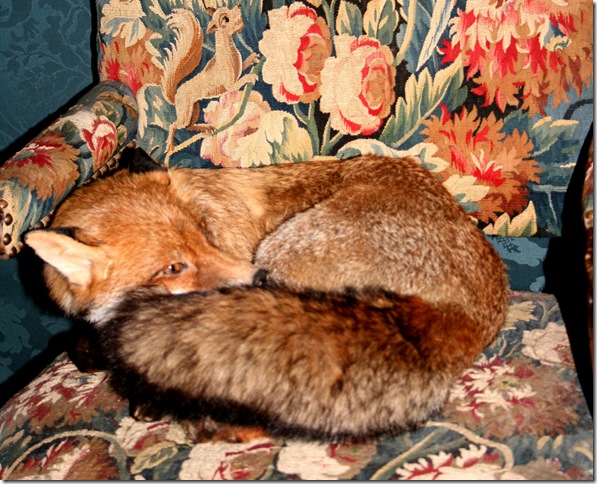

fox in chairillustration of point: a stuffed? fox in a vintage chair? Well, Hello there!! jumped of course a little bit just as planned by the exhibitors!


And what about these creatures: paris march april 2011 108Grrrrr… ooops! Not this is not what one would expect to find in a living room, is it?


And here, facing the Grey European Wolf – on parquetted imported hardwood floor floating with Persian carpets we find the Stunning and Dignified Stag… paris march april 2011 106


It is an amazing job the taxidermists have done on these creatures… and the approach behind the display is stunning: The Wolf and the Stag facing each other in a Very Posh salon… Both animals are positioned in front of large tapestries depicting allegorical hunting scenes - can you see the stag in the 15th C tapestry directly behind it? and with corresponding paintings on the walls and a very comfy seating area in the middle of the room it gives you the peace and quiet and space to read the very good descriptions on separate information leaflets leaving you with a very properly rendered historical and philosophical context for the images we see around us.


paris march april 2011 103


I just loved this place.


Created as an offspring of the foundation “Fondation de la Chasse et de la Nature” in 1964 by the famuos conservationist and industrialist couple Francois and Jaqueline Sommer it had a twofold aim: one to support and inspire ethical hunting that respects the balance in nature and secondly to show the vast collection of hunted related artworks and objects the couple had collected.


paris march april 2011 132


The collection is enriched with loans from many other nature and art-related institutions as well as embellished with modern pieces. Together the mix create an eclectic, intelligent and humourous combination that want you to stay on and on reading, exploring, feeling, thinking…. The contrast to the elegant surroundings of the mansion, The Hotel de Guenegaud (app. 1650, attributed to the architect Francois Mansart) which, at the beginning of the project was in a sorry state of disrepair, is intentional: the restoration project had as a goal to “recreate” the decor of a typical eighteenth-century collector and wow how it does that well. Being a “work in progress” so to speak it is not a fixed set of displays – rather, the institution strive to embrace recent and truly up to date and contemporary ideas related to both art, philospohy and conservation within a genuine historical context, and it is therefore able to show the relevance of history as well as remining us about the neverending possibility for freshness in an istitutional approach that should get the juices flowing for anyone related to the public sphere:) (Hear! Hear!)
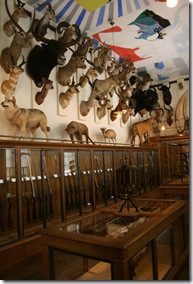

paris march april 2011 137paris march april 2011 136


Let us look at this typical “Trophy” room. It is kinda scary, but also impressive…I had to allow it to sink in for awhile before embracing it. I would, for instance, like to point your attention to the VERY contemporary ceiling treatment – just one of those quirky touches that leaves us – or at least me! with an impression of freshness to this collection that would otherwise have felt both stuffy and depressive given the fact that all these animals have lost their lives due to the personal eagerness to show off importance and social status through mastering the life and death of other living beings, holding them captivated even after their death… But that is all done oh so long time ago and it IS remarcably done so lets put the current politically correct moral aspect aside for now to allow us to indulge in the visual experience of the place: Personally I would have liked the ceiling frescoe to have been a little more coherent designwise as I feel venerance towards these creatures even in their aftermath and it is to hope that another artist with less of a degree of distance to the subject matter surrounding him will be given the task in the future to mirror the collection in a less visually confrontational way. (Me, for instance;)!) Equally, or even more impressive is the display of artefacts connected to the hunting


paris march april 2011 116


this image show one of many different original dog collars used in hunting – the spikes is to prevent the dog from being killed by suffocation by wolves: they were also wearing heavily quilted vests made out of horse hair to protect them from the razor-sharp tusks of the Boar…. Wow!


The collection shows the part hunting has played in civilization– mostly Western - but it also higlights the evolution of the status of wild animals in the human mind – always a fascinating subject. From the ancient veneration of Predators as animals to be feared as well as respected, to the veneration of the Wild Boar as the Ultimate hunting Subject only for the Experienced Craftsman to dare going after (the favourite object of hunt for the Roman Goddess Diane), the hierarcy of animals in the mind of people shifted quite abruptly with the advent of Christianity. The Wolf, especially, was seen as Evil incarnated due to its preying of lambs, the image of Christ, and no means however cruel and lowly was allowed in its persecution. On the opposite end, the Stag, with its antlers falling off and growing back was seen as equivalent to the resurrection of Christ, and its 10 points the equivalent of the 10 Commandments and therefore the hunting of this animal took on Very Dignified proportions … which we can see in the care, dilligence and artistic wonders the hunting tools were shaped.


paris march april 2011 158


Later development, particularily the advent of Humanism, moved animals away in Western conception from being Creatures of Divine making (albeit underlying Mans dominance) to pure Utilitarian consideration. The usefulness of the Domestic animals came to the forefront, with the Dog as its most useful, lojal and therefore Dignified of Creatures.


paris march april 2011 133


Jeff Koons contemporaty Terrier sculpture in porcelaine on marble top table with 17 century fox hunting trumpet in front next to it, 18th century hunting hound portrait on the wall in the background.


The historical descriptions given on the information leaflets together with the actual displays of genuine historical artefacts was an eye opener to me. I am reasonably well read in European Intellectual history as well as in Philosophy (apologize already now for a later rambling indulgence); I think I have mentioned somewhere that did one semester studying Classical Mythology in Rome pairing it with art history and literature -Classical as well as Baroque to get a better grasp of allegorical representations of Mythological subjects in writing, architecture and Arts- but coming from a rather Barbarian country, who – thanx heavens – (and sorry if I offend someone!) –have kept their love and closeness to the wilderness somewhat intact - never really have had the opportunity before now to see this amazing wealth of artifacts combined with the scientific understanding juxtaposed and contextualized in the historical setting – and place! - in the way they manage to do here (Rome is WONDERFUL, but it is, after all, the city where the Vatican is placed… so they do not overdo the Scientific approach to things, do they, competing for positions at the Papal Court … sorry again…))


Allow me to take one example that for me helped to put things into context and grabbed my attention.


Have a look at this painting. It seems a bit oversweet and kinda… kitchy, no? I walked by giving it no special attention, but as I grabbed one of the forementioned explanation sheets and put myself comfortable to read (yes, I did spend about 5-6 hours there, and I DID read it all…) I nearly jumped out of my comfy sofa to get a closer look (and take this photo)


paris march april 2011 131 J. B Oudryas “Bitch feeding her pups” 1753


This image, Ladies and Gentlemen, however overly… posed? we might find it now, is one of the very first painting of an animal showing emotions. It is a genuine response to the new sensitivety towards animals, and a true expression of a release from symbolic prepresentations of the world. Amazing, isn’t it?! Of course, what caused this shift in sensibility was a complex process strenghtened by the creation of the public sphere and the informed reader through Gutenbergs printing press and later newspapers; the growth of a middle class, the shift from drinks to alcoholic to non alcoholic beverages etc etc through the coffee houses that we all know almost by heart and ad infinitum and so forth and of course the great shift in economical prosperity that made Individualism a way of life possible for a vastly larger number of people than anytime possible in the History and the Colonializations etc etc (sorry if I am lecturing just my head is full of these things so …) all this made some very important aspects of Renee Descartes (1596-1650) philosophy being met with a public outcry (you know, the Cogito ergo sum which severs the bond to religious worldviews and unravel the Authoritarian hegemony to knowledge etc etc which opens up for a total Materialism etc etc… sorry again but is is important to keep these aspects somewhere in the back of the mind to get things right here).


Descartes wrote that animals could not feel suffering. His writings have been used / and someplace still are / as a justification to use animals in testing. Now, this might be my own mistake, but somehow it has evaded me through the reading until now that this postulate was objected against so strongly already in his contemporary time – and for sure this is the first time I see it mentioned and oh so well illustrated - from dog owners!!


Now these obviously Bourgeouise readers who equally obviously belonged to the fashionable circle of “modernist” subscription readers of his writings came to protest very loudly and publicly when he denied that animals could feel suffering. They were attentive to canine behaviour and they found in their pets and hunting companions an acute ability to express feelings and emotions that shook the foundation of a worldview that placed Men above Nature.


And so it was that the New Modern Man - and Woman – found themselves not only accompanied by feeling beasts and companions worthy of respect and loving care: but also the sexes found themselves in company of fellow human beings with whom they could share feelings, thoughts and emotions on a scale and in depth never before being experienced – but that is a subject which will have to wait. Let me just mention already now that this development has been the subject of a whole range of books including one,especially, of 43 books and hundreds if not thousands of articles written by the now forgotten writer and literature critic Hjalmar Elster Christensen (1869-1925) – my Great Grandfather on the maternal side -on the evolution of Human Emotions through the Enlightenment age (his dissertation was on the writings of Flaubert).


Until now I did not get it. Your Humble Writer has diligently worked her way through most of his writings, but due to lack of proper insight in the French side of things (and he was VERY much into continental philosophy and literature) I could not get hold of the flavour of it, so to speak. It is a little bit better now, but there is still a LOT of work to be done to get it right.


Perhaps it will be possible to frame my dissertation on Individualism at one point after some more reading and ramblings after all? that would be nice….


thank you for reading! Now go gardening of which I will post something about later;)

Sunday, 27 March 2011

Traces…

We just came home to the Mara after a wonderful time in Samburu – and I noticed something strange just next to our tent that I had not noticed before…

Marks on mountain, Kalama

Marks on mountain, Kalama (2)

can you see that there are marks on the rock?

I pondered what this might be for a while and then one earlymorning the solution presented itself in person: this is the place the night watchman sharpens his sword!

Drawing safari october 2009 (44)

I asked the warriors whether they normally return to the same place to sharpen their swords and spears, but they said when out and about they just find a place on a rock that is smooth and sharpen it there… and this mark is there solely because it is a convenient place and he happens to be there every day… so, next time you see a mark like this on a rock somewhere, take time to think about the likely possibility that someone passed there before you in a different time, a different world… and say hello in your heart!

Monday, 7 March 2011

Chasing Dreams.

The more I work, the more I feel an almost physical need to go back to the basics re-learning (and some times un-learn) fundamental elements in drawing. Being on my own I try to learn from books as well as through my own work, stretching my abilities, being honest about the fear and panic that sometimes comes out of the blue when I feel lost, keeping the goal open, trying to let the process show the way to new discoveries. Trying to be kind to myself when I get frustrated, leaving things as they are instead of overworking, starting afresh with the new problem at hand instead of doodeling around. It is scary. But it is the only way to progress.

Illustration of point: I have since long felt a need to include more elements in my paintings. I felt I had done enough of the silent landscapes and it felt like I was about to repeat myself. Not good. So I looked through some photos I had taken and found a scene I liked: a Maasai sheperd walking home from Aitong after a day out grazing his herd.

Maasai shepard 

I combined that with a painting I had started on but had gotten stuck with out of fear of “destroying it”:

my paintings a (2)

and it ended up like this:

New paintings march 2011 004 full size

(Walking home, acrylic on canvas 100X130 cm)

Now, it is not perfect, I know. But I am going to allow it to stay like this. In fact, I am taking it to an exhibition that I am having in the town of Nanuki opening next week to see what the reactions are.

I also made a smaller version of the sheperd using more decorative elements to see how that could come out:

New paintings march 2011 005 full size

(Acrylic on MDF, 20X30 cm)

So, now I have a new world to explore. Let’s see where the road goes…

dealing with this more naturalistic approach led me to read again Betty Edwards book on drawing actually doing again all the exersizes that I have somehow dreaded. It went well with reading Buddhist philosophy (H.H. Dalai Lama, “How to see yourself as you really are”) art philosophy (Rudolf Arnheims “Visual Thinking” and R.G.Collingwoods “Outlines of a Philosophy on Art” are books I come back to again and again). Books on writing &creativity (Steven Pressfields “the War of Art” is a MUST for anyone stuck anywhere, anytime) as well as other miscellanious things. Listening with an open mind make me realize how many similarities there are regarding battles we all must face, and how many ways to solve them that exist. So, it is realistic (to say it with His Holiness) to work on attaining some insight as it surely is more beneficial than living in a world of illusions and misunderstandings. And we need help, because many ways that works are counter-intuitive until we are shown how it works. So I am very grateful that these people have worked so hard to show their way so we all can benefit in our own processes, whatever they might be.

Engaging in a craft, with the aim to master it  is a very good tool indeed for living a good life. (Dog breeder? Cultivator of wines? Carpenter? Writer? Trombone player? Fashionista? sure! Bureaucrat? mmm… no comments… but perhaps he or she does something creative in after-hours?)

I have to understand the dimentionality, solidity, angle, flavour, weight and lightness of my subject in its context before I can draw or paint it successfully. Some call that empathy with the subject. I empathise with this idea. But, at the same time, it is scary. I realize my shortcomings. It takes a lot of dedicated time and real battles with inner Demons to be allowed to enter unknown territories. But, since we only live one life at a time we can just as well take on the job of living it fully. Marcus Aurelius wrote: “Don’t be disturbed. Uncomplicate yourself. … Life is short, That’s all there is to say.”

So easy. So difficult.

Sunday, 27 February 2011

How the Zebra got its stripes

When I first moved out to Kenya, a friend gave me a vintage book with Swahili myths and stories. It had many interesting and fun tales to tell, but regardless of those, the stories I have been told by our guides and staff are far more interesting as I recon those are stories told by their Grandmothers around the fireplace as entertainment and education. So they are a living record of a tribal understanding of the world…

Most stories include God. Or Laibon, as they call him here. Laibon created all the animals as well as the different peoples. When he had done so he had them coming to him with requests for things they wanted or needed (which is of course asking for trouble…). The maasai asked for cows and was given them – meaning all the cows in the world belongs to the Maasai and therefore they only take back what was originally given to them when they go for cattle raids… The white man asked for knowledge (and until recently the Maasai thought very little of it, but now they have started to change their minds a bit an elder told us. It must be the cellphones…).But I am sidetracking myself.  This morning it was the story of the Zebra I wanted to share. It came naturally to my mind as I went out to put on my coffee this morning.

The pyjamaman is here! Funfun!  It always makes me smile! But. What is this thing with the stripes?

a zebra through the gate

Well, you see, it happened like this. The animals had been on Earth for a while and was getting used to it. And they were getting bored. Everyone looked the same! grey brown grey brown everywhere. Blah! So they went to God to complain…

By now Laibon was getting a bit fed up by these constant demands for attention and needs and wants from the creatures he had created so he told them: ok ok, I will do it. But you have to find out among yourself how to distribute it: I will place a variety of materials in a cave and it should be suficcient for all of you but I refuse to be involved in the designs…

All the animals were very happy when they heard this, and so they started the journey to the cave with all the materials. The zebras, saw the migration, and, being a bit greedy, they said to eachother: wow! look at this! everyone is gone, the plains are all ours! lets eat! and they ate and ate… as the different animals started to come back looking really sazzy and smart they said to each other: wow! look! The lion! cool! I want a mane like that! and the Peacock! What feathers! I want those too! But they continued to eat as much as they could…

Finally they realized that everyone had returned so they went to the cave… but, alas! the only thing left was a small piece of black cloth… that would had been just enough if the zebra had not kindof put on somewhat after his bingeing earlier on the plain with all the others gone. …so… after much huffing and puffing and pulling and squeezing it finally had his new suit on. But! as it started to move a big Crack! Riiip!!! was heard, and the suit snapped in all its seams!

a zebra and embe

And so it was that the zebra came to get its stripes.